
Published by GAD Software
Experts in Workflow Automation, AI Enablement, and Operational Systems Integration for Modern Businesses.
In the fuel and petroleum distribution industry, operational speed and accuracy matter. Delays in approvals, manual paperwork, disconnected spreadsheets, and repetitive administrative tasks can quietly reduce efficiency across the entire business.
Workflow automation helps companies eliminate these operational bottlenecks by replacing repetitive manual processes with structured digital workflows.
For fuel distributors, workflow automation is not about replacing people. It is about enabling teams to operate faster, more accurately, and with better visibility across operations.
What Is Workflow Automation?
Workflow automation is the use of software systems to automatically manage business processes, approvals, notifications, document routing, and operational tasks based on predefined rules.
Instead of relying on:
- Emails
- Spreadsheets
- Phone calls
- Paper forms
- Manual follow-ups
Automation platforms coordinate these processes automatically.
For example:
- Invoices can route automatically for approval
- Dispatch reports can trigger alerts
- Inventory thresholds can generate notifications
- Customer requests can create service workflows
- Field inspections can synchronize with office systems
The goal is operational efficiency, consistency, and visibility.
Common Operational Challenges in Fuel Distribution
Many fuel distributors still depend heavily on manual processes.
These often include:
- Manual invoice approvals
- Spreadsheet-based inventory tracking
- Disconnected dispatch coordination
- Paper inspection forms
- Email-heavy communication
- Repetitive reporting tasks
As operations scale, these workflows become increasingly difficult to manage.
The result can include:
- Delayed approvals
- Operational blind spots
- Duplicated work
- Higher error rates
- Slower customer response times
Workflow automation addresses these problems systematically.
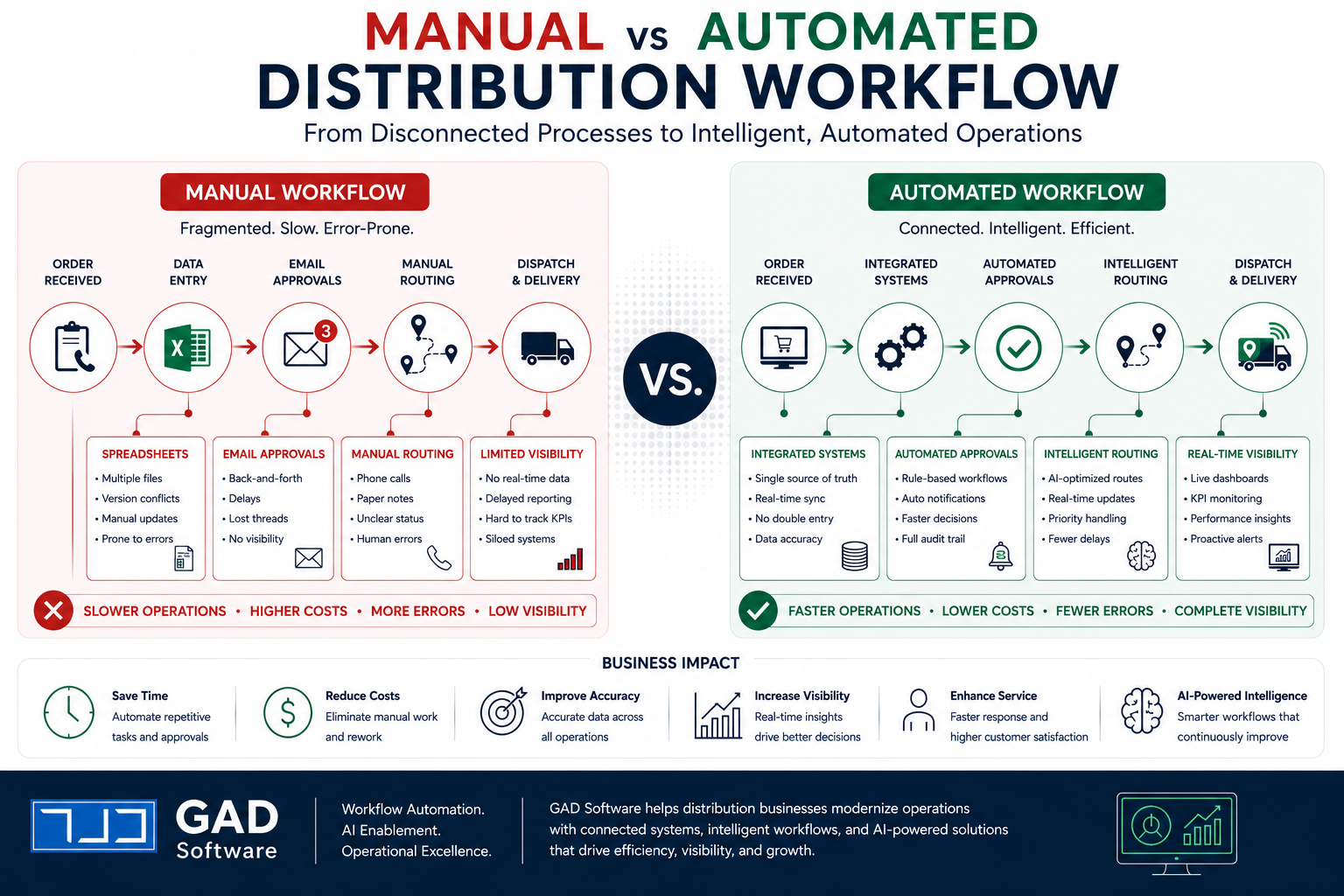
The difference between fragmented manual operations and connected automated workflows becomes especially clear when visualized operationally:
Examples of Workflow Automation in Distribution Operations
Invoice Approval Automation
Instead of manually emailing invoices between departments:
- Invoices are automatically routed
- Approval status is tracked
- Reminders are triggered automatically
- ERP systems update in real time
Dispatch Coordination Workflows
Automation can:
- Notify drivers
- Update delivery status
- Synchronize dispatch schedules
- Trigger customer notifications
Maintenance & Inspection Workflows
Field inspections can:
- Be completed digitally
- Upload photos automatically
- Trigger corrective action workflows
- Generate compliance records
Reporting Automation
Operational reports can be:
- Generated automatically
- Delivered on schedule
- Connected to live business data
Looking to modernize operational workflows?
Schedule a consultation with GAD Software to evaluate automation opportunities in your business.
Benefits of Workflow Automation
Increased Operational Efficiency
Teams spend less time on repetitive tasks and more time on operational decision-making.
Improved Visibility
Managers gain real-time visibility into approvals, operational delays, and workflow status.
Reduced Human Error
Automation standardizes processes and reduces manual mistakes.
Faster Decision-Making
Operational data becomes easier to access and act upon.
Better Scalability
As the business grows, workflows remain manageable and structured.
Where Companies Should Start
Many organizations believe automation requires replacing all existing systems.
In reality, effective automation usually starts small.
Common starting points include:
- Invoice approvals
- Document processing
- Reporting workflows
- Maintenance requests
- Customer intake processes
The most successful automation initiatives focus first on high-friction operational areas.
The Future of Distribution Operations
AI and workflow automation are increasingly becoming part of modern operational infrastructure.
Companies that modernize early gain advantages in:
- Responsiveness
- Operational efficiency
- Visibility
- Scalability
- Customer service
Workflow automation is no longer only for large enterprises. Modern cloud platforms now allow mid-sized distributors to implement powerful operational systems incrementally.
Conclusion
Workflow automation helps fuel and petroleum distributors reduce operational friction and improve efficiency across the organization.
By digitizing repetitive workflows and connecting operational systems, businesses can create more scalable, responsive, and data-driven operations.
As industries continue modernizing, operational automation is becoming a strategic advantage rather than an optional improvement.
About GAD Software
GAD Software is a consulting and technology firm specializing in workflow automation, AI enablement, operational systems integration, and business process optimization.
We help organizations modernize operations through connected systems, intelligent workflows, and scalable automation solutions.
Last Updated: May 11, 2026
Related Services
Learn more about how we can help transform your operations:
Explore Automation Opportunities for Your Business
Every distribution operation is different. Whether you're starting to explore workflow automation or looking to expand existing capabilities, we're here to help you identify the right approach.